

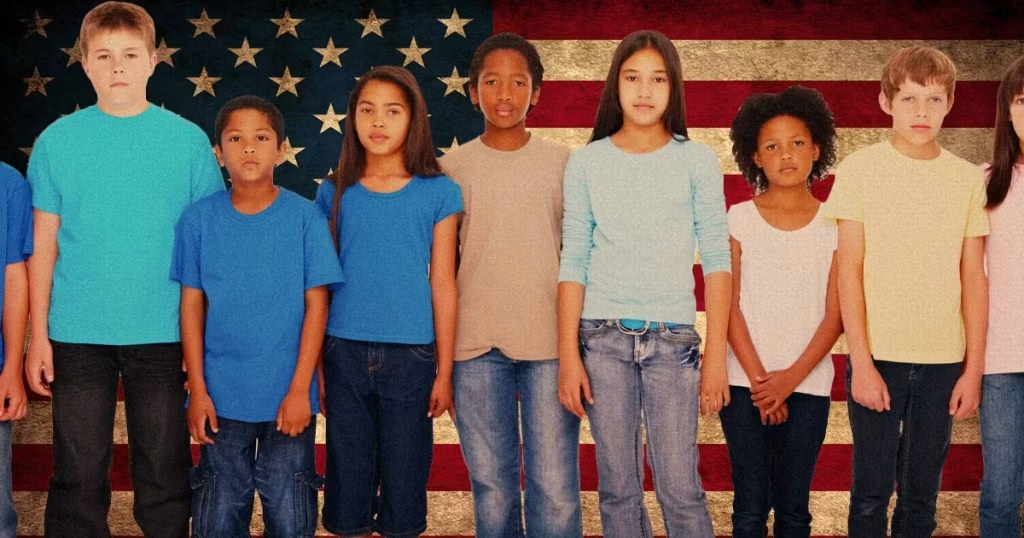
American children face a tough reality right now, with millions struggling in ways that demand immediate attention. As of 2025, about 73 million kids under 18 live in the U.S., but many deal with broken families, money woes, and emotional pain. Compared to the world, the U.S. ranks poorly among wealthy nations, trailing in family stability, poverty, and mental health. America must step up fast to help these young ones thrive.

Family Structures Break Apart
First, look at homes where American children grow up. Nearly 29% of them—21 million—do not live with two parents, often in single-mom setups or with grandparents. This rate is high globally, where only 7% of children live in single-parent homes, though rates climb to 15-20% in peers like the UK. Nordic countries (e.g., Sweden, ~15%) and Japan (<5%) show stronger family unity. Because of this, U.S. kids face more stress and fewer resources. These setups increase risks like poor school performance and health issues.
Additionally, only 8% of American children stay with extended family, far below the global 38%, leaving many without extra support. However, strong community ties can buffer some harms, yet the trend alarms experts.
Poverty Strikes Deep
Poverty affects American children more than in most rich nations. In 2023, 16% of kids—over 11 million—lived in poverty, up from recent lows. This doubles the rate in countries like Denmark (~5%) but sits below extreme poverty in places like South Sudan (82%). Single-parent families suffer most, with 30% below the poverty line versus 6% in two-parent homes. Because food insecurity and unstable housing follow, these children miss basics like healthy meals.
Mental Health Demands Action
The mental health of American children rings alarm bells. One in five kids ages 3-17 has a diagnosed mental, emotional, or behavioral issue, higher than the global 14% for adolescents. Anxiety hits 11%, depression 4%, and behavior problems 8%. Among teens, 40% report sadness, worse than many Organization for Economic Cooperation (OECD) peers. Because social media plays a big role, parents worry—53% say technology harms well-being.
Moreover, cyberbullying affects nearly half of teens, worsening isolation. However, positive adult support reaches 79% of adolescents, offering hope. American children need more competent counselors, as the U.S. lags in mental health resources compared to countries like Australia.
Technology Offers Risks and Tools
Technology shapes how American children cope daily. About 70% of teens own smartphones, and 23-33% of vulnerable kids use AI chatbots for emotional support, a trend rising globally (e.g., China, Denmark). Because screens provide escape, 76% in single-parent homes rely on them, but overuse links to poorer mental health, a global concern. Caregivers who have their eyes on their devices, instead of the children, exacerbate this problem.
Additionally, digital tools can build skills, yet risks like bias algorithms, or other skewed result, e.g. political influence twist the possibility of a positive outcomes An algorithm is a set of well-defined instructions or rules designed to solve a problem or perform a computation. It is a step-by-step procedure that takes an input, processes it through a series of steps, and produces an output. Algorithms are fundamental to computer science and are used in various fields such as mathematics, artificial intelligence, data science, and operations research. Algorithms loom large in todays world. Parents must guide usage, as 81% of youth depend on tech for fun, but it can also lead to emotional or even physical harm, similar to global patterns.
Paths to Better Futures
Overall, Trump’s 2025 administration has issued over 76 Executive Orders by March 2025, several touching on children’s issues, such as global health actions that indirectly benefit youth through disease prevention and drug addiction. He is actively implementing Agenda47 promises, like protecting students from ideological influences, getting back to basics, and addressing mental health through anti-indoctrination measures in education. The administration has prioritize family autonomy and long-term well-being, including tax credits. Children 18 and older are beginning to see the value of hard work and a healthy life. Charlie Kirk, along with many others, was one of those who was massively received by today’s youth. Their response is a stark example their yearning for stability, hope, and a future.
Society is pushing forward with programs for American children. Only 5% lack health coverage, a win over many nations. Education is starting to see higher graduation rates, though scores lag way behind top countries like Finland. Moreover, addressing parental stress helps, as happy caregivers raise healthier children. Urgent steps must continue to be taken now to ensure brighter tomorrows for American children-our leaders. What do you think needs to be done to give our children a solid and healthy future?